New Zealands vegetable growers face a big challenge: soil degradation from years of intensive farming and heavy fertiliser use. But there’s good news on the horizon! Our latest research at Massey University reveals that natural soil amendments, chicken manure, biochar, and organic waste compost can dramatically boost lettuce growth and soil health.
Osflo was selected as the source of chicken litter for the trial because its product is both BioGro and Fertmark certified. These independent certifications provided researchers with confidence in the consistency, quality, and reliability of the amendment, ensuring a robust foundation for the study.
- Chicken manure stood out for its positive impact: Lettuce grown with 10 t C ha-1 chicken manure showed more than double the chlorophyll content and photosynthetic rates compared to untreated plants. Moreover, lettuce treated with chicken manure produced a 5-fold higher yield than the untreated plants. This improvement is linked to the high levels of mineralizable nitrogen in chicken manure, supporting greener, healthier, and more productive crops.
- The results suggest that chicken manure can be a valuable addition to soil management strategies, especially when used thoughtfully and in combination with other organic amendments for both immediate and long-term benefits.
- Smart combinations payoff: Using half the usual amount of chicken manure (5 t C ha-1), combined with compost or biochar (5 t C ha-1), still achieved around 84% of maximum yield obtained from full-dosechicken manure treatment. This opens the door to cost-effective, sustainable nutrient management.
- Biochar and compost build long-term resilience: Both amendments improved soil structure, pH, and water retention, supporting healthier soils for future harvests.
Our results show that integrating organic amendments, especially chicken manure, can help growers achieve higher yields, while combining CM with BC or OW at 5 t C ha⁻¹ each offers a viable long-term strategy to partially replace manure inputs and sustain soil fertility.
Let’s grow a more sustainable future together!
Lettuce plant growth was visually assessed 12 weeks after transplanting or one day before harvesting date, and differences among the treatments were observed (Figure 1). All treatments with soil amendments showed a marked increase in growth compared to the control. The treatments incorporated with full-dose and half-dose chicken manure exhibited outstanding growth and yield compared to others without chicken manure. In the soil-only treatments, lettuce plants exhibited marginal chlorosis of older leaves, stunted growth, with thin and weak leaves showing browning along the edges, and not forming proper head due to nutrient deficiency
Compared to the control (soil-only), the addition of different soil amendments resulted in significant soil fertility improvement (Figure 1). Among all soil amendments, soil amended with chicken manure exhibited the highest nitrogen availability in soil, approximately 4.3-fold greater than the control. This contributed to outstanding plant growth and head formation (Figure 2).
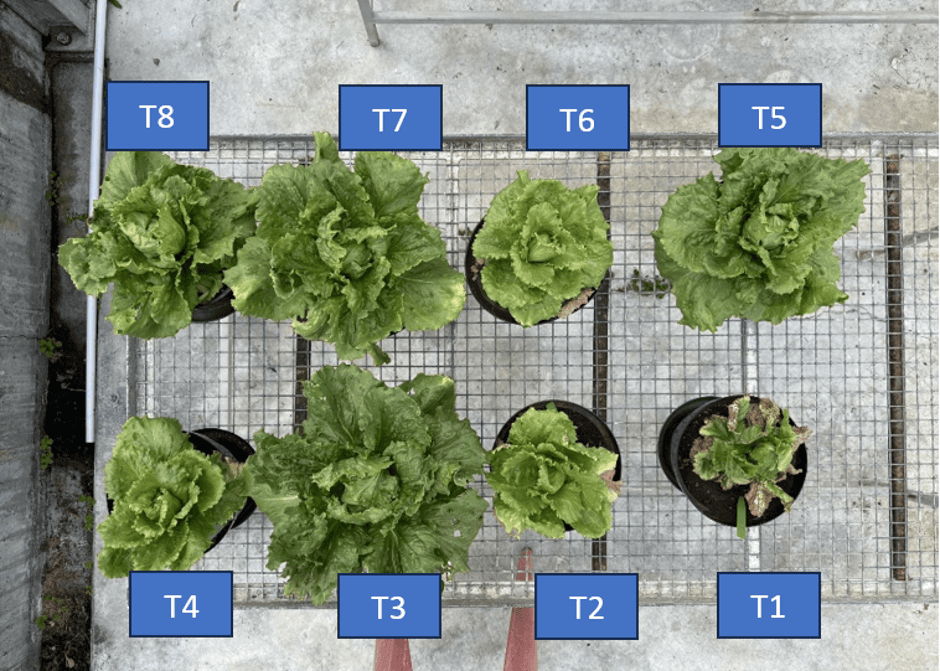
Figure 1: Lettuce grown under different soil amendment treatments 12 weeks after transplanting : (T1) control (no amendment), (T2) biochar (BC, 10 t C ha-1), (T3) chicken manure (CM, 10 t C ha-1), (T4) organic waste compost (OW, 10 t C ha-1), (T5) chicken manure + biochar (CM + BC, 5 t C ha-1), (T6) biochar + organic wate compost (CM + OW, 5 t C ha-1)(T7) chicken manure + organic waste compost (CM + OW, 5 t C ha-1), and (T8) chicken manure + biochar + organic waste compost (CM + BC + OW, 3 t C ha-1)
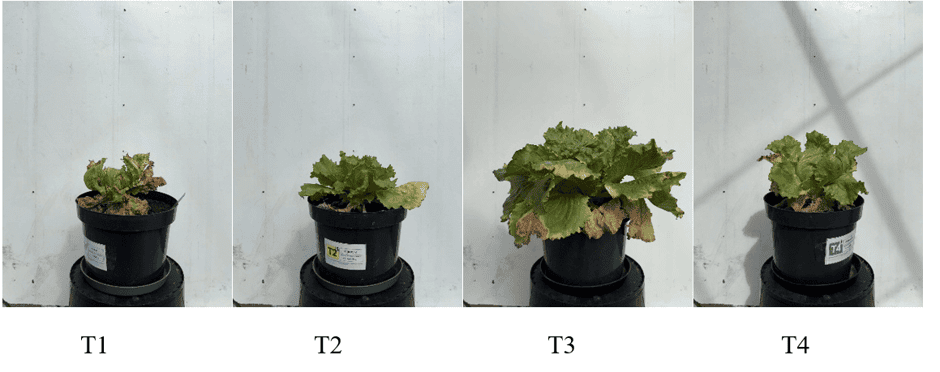
Figure 2 Lettuce grown without soil amendment (control)(T1) and with amendments: biochar (BC)(T2), chicken manure (CM)(T3), and organic waste compost (OW)(T4) applied at 10 t C ha-1
For more details, read on.
ENHANCING VEGETABLE PRODUCTION AND NUTRIENT COMPOSITION THROUGH SOIL AMENDMENTS
This report evaluates the effects of biochar, chicken manure, and organic waste compost—applied alone and in combination—on lettuce growth and soil health in New Zealand.
Key Points
Background & Purpose
Intensive vegetable farming in New Zealand has led to soil degradation and heavy reliance on synthetic fertilisers.
The study aims to assess how organic amendments (biochar, chicken manure, compost) applied individually and in combination can improve soil fertility, plant growth, and sustainability.
Methodology
Eight treatments (including control, single, and combined amendments) were tested in a controlled pot trial, each with equal total carbon input.
Lettuce was used as the test crop, and soil/plant properties were measured throughout the 12-week experiment.
Results
All amendments improved plant growth compared to the control.
Chicken manure (CM) had the strongest effect, more than doubling chlorophyll content and photosynthetic rates due to its high mineralizable nitrogen. In addition, lettuce with full-dose of chicken manure provided roughly 5-fold higher than the unamended control.
Half-dose CM combined with compost or biochar also enhanced performance by about 80- 84% of the maximum yield, while using 50% less manure, suggesting cost-effective nutrient use is possible.
Biochar acted mainly as a soil conditioner, improving pH, cation exchange, and water retention, with effects similar to compost.
Soils with CM showed very high ammonium-N but low nitrate-N, indicating delayed nitrification and the need for careful rate management.
Discussion & Implications
Chicken manure is highly effective for short-term gains, but integrated approaches (combining amendments) may better support long-term soil fertility and sustainability.
The study highlights the importance of optimising amendment rates to balance productivity, cost, and environmental impact. This research provides evidence that organic amendments, especially Osflo chicken manure, can significantly enhance vegetable production and soil health, with potential for more sustainable horticultural practices in New Zealand. We also observed that lettuce treated with chicken manure in combination with other amendments showed a healthier and more vigorous morphological appearance compared to other treatments (Figure 3), indicating that chicken manure is the dominant factor contributing to this growth.
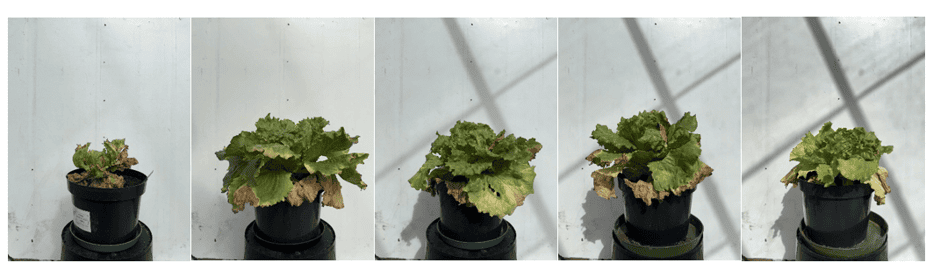
Figure 3: Lettuce grown in soil (Control) and with the following amendments: chicken manure (CM, 10 t C ha-1), chicken manure + biochar (CM + BC, 5 t C ha-1), chicken manure + organic waste compost (CM + OW, 5 t C ha-1), and chicken manure + biochar + organic waste compost (CM + BC + OW, 3 t C ha-1).
School of Agriculture and Environment – Massey University – Palmerston North
RESEARCH TEAM Pantamit Saekong, Rukshagini Sutharsan, Svetla Sofkova-Bobcheva, Chris Anderson, and Paramsothy Jeyakumar
Research report submitted to Horticultural Executive Services Ltd: June-September 2025
Special mention of thanks to Pantamit for agreeing to publish his research online.